Marc Karell is the owner of the consulting firm Climate Change & Environmental Services, LLC (website: www.CCESworld.com). He is a licensed professional engineer (P.E.) in the State of New York with over 30 years of technical consulting experience in the areas of energy, climate change, sustainability, and air and environmental compliance. He is also a Certified Energy Manager and an Existing Building Commissioning Professional with a Masters Degree in Chemical Engineering from Columbia University.
Marc has a passion for environmental and energy issues and started his firm, CCES, in 2009. Since then, Marc has served a wide variety of client types, large and small, to help them deal with issues involving energy and the environment. He knows these are new, confusing, technical subjects. However, there is opportunity out there and a company making the right technical choices can benefit tremendously financially and stay ahead of the competition. Marc provides technical options to firms.
In addition, CCES has no employees besides Marc. He will gladly bring in technical specialists, when needed, for a client. And CCES clients know that Marc, with 30+ years of experience, will be intimately involved in their projects and is responsible for their success. No young “kid” right out of school will be thrown out there to perform evaluations for you!
Marc has extensive experience performing ASHRAE Level I, II, and III energy audits for diverse building types (such as office buildings, schools, warehouses, and multi-families) in the New York City Metropolitan area and nationally. Marc also performs building retro-commissioning evaluations, to assure building owners that their systems are operating optimally (they are getting their money’s worth). Marc has combined both his energy auditing and retro-commissioning experience to help dozens of buildings comply with New York City’s Local Law 87, mandatory energy auditing and retro-commissioning for large buildings, discovering many opportunities for savings in buildings. Marc uses this knowledge to perform project management projects for clients to ensure that energy savings are fully realized in the actual implementation of upgrades.
Marc also performs greenhouse gas emission inventories (carbon footprints), green building assessments, and has led training to ensure that operators understand how to maintain their energy upgrade strategies so that they continue to benefit the building in the future.
Marc also performs evaluations of air emissions from commercial and industrial processes, including emission inventories, design of air pollution control equipment, permitting, and evaluation of potential health effects of air toxics.
Marc has performed successful projects for such major firms as ExxonMobil, Alberto-Culver, Toyota, Regeneron, Cytec, New York Medical College, the United Nations, and the New York Archdiocese.
Marc Karell can be reached at 914-584-6720 or at Karell@CCESworld.com. Do not hesitate to contact him for a free preliminary consultation. Good luck in your environmental and clean energy journey!
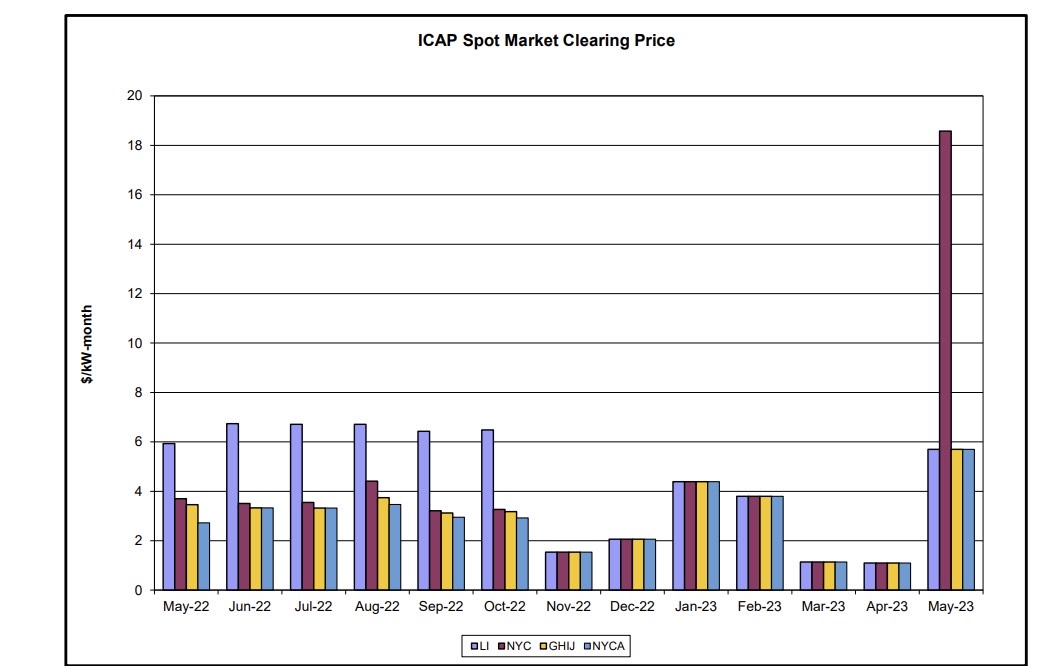
As we noted in our article “What to know about energy markets”, energy markets are the most volatile we’ve seen in over a decade. Both energy and capacity markets have grown more dynamic and volatile as you can tell from May-23 in the figure ICAP Spot Market Clearing Price. While we can point to some factors driving this volatility, it is nearly impossible to predict how the market will look in the future. What is clear, however, is that as we phase out natural gas and fossil fuels, it is even more important to pay attention to energy markets and to pay attention to the dynamics of the energy transition.
Take Advantage of Energy Market Conditions
It is important to remember that energy markets are financial markets. The most significant determinant of your costs as a buyer is when you buy– it is more important than what product or what approach you take to buying. You can manage your energy costs and look at markets to inform decisions.
In addition to paying attention to markets, the following strategies can help you as you navigate these volatile market trends.
6 Keys to Navigating Volatility
Understand market dynamics: Understanding where we are, what the history of the market is, and what the forward curve looks like is important to informing decision making. When you are operating in markets that are this volatile, it is also important to be realistic about the impact of financial markets on future costs… most customers try to plan their budgets using prior realized costs. We don’t recommend doing that. Get a forecast using current forward markets.
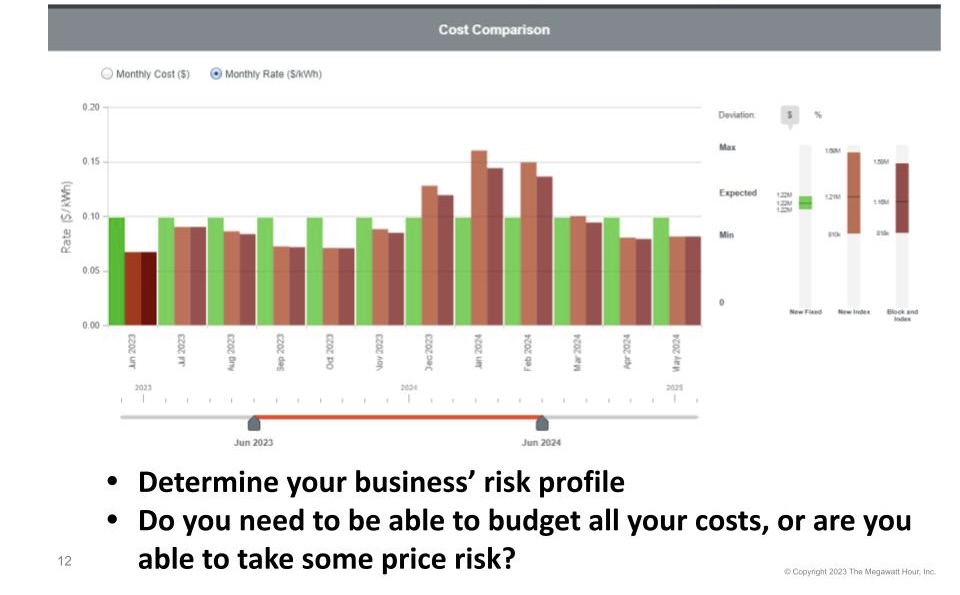
Determine your risk appetite: Determine your business’ risk profile. Taking risks can be beneficial depending on your company’s risk appetite. Having the flexibility to take risks in the power and gas markets may result in lower costs over time. You have options when you engage in energy markets. You do not have to just purchase a fixed price or an index rate.
The following graph compares the monthly unit rate for 3 different energy products: a fixed price, in green, an index, in dark red or a hybrid of these two options: The index with a block of power. You need to determine what matters most to you as an organization. Then you need to be actively engaged in purchasing to make sure your purchasing strategy matches your institution’s goals: Do you prioritize budget certainty over cost? Are you willing to take some risk and let some parts of your cost float on an index? This is one of the most important conversations you can have as an organization. We would recommend that you revisit the strategy conversation regularly as markets evolve.
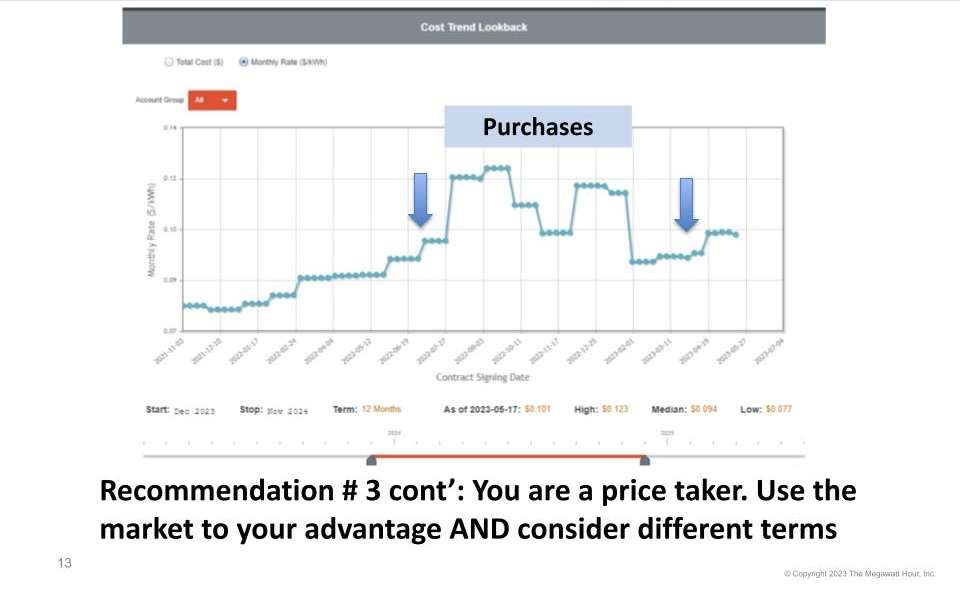
Take advantage of volatility: Assuming your business is operating well and is stable, you will always be in a position to make energy purchases well into the future. You don’t need to be passive and accept pricing delivered just months or weeks before your contract expires. Purchasing energy in advance before your current contract ends will allow you to take advantage of volatility rather than being subject to it. How do you know whether to buy? Well, if you’ve determined your risk appetite and budget targets, then you will want to look for products and pricing that meet those goals.
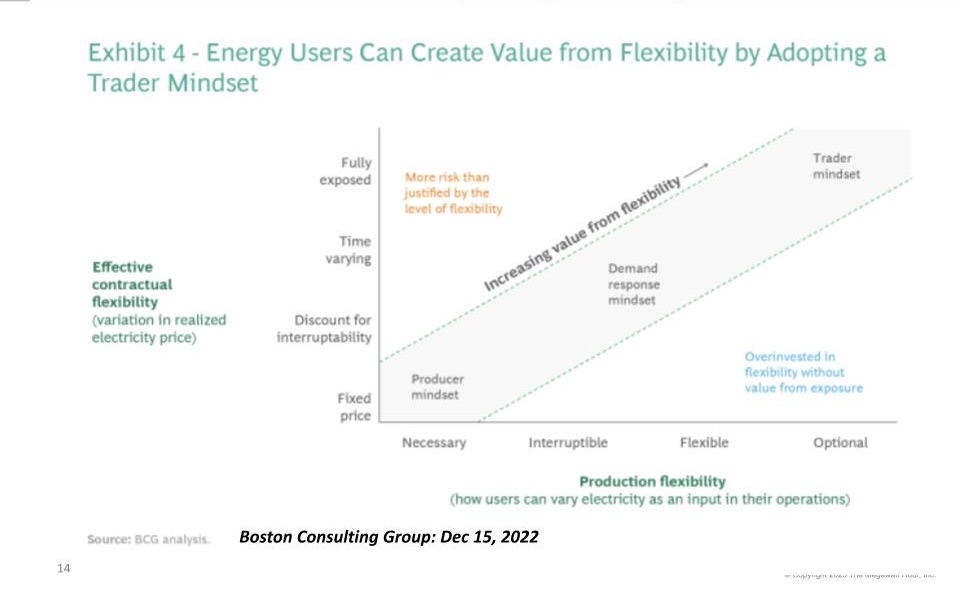
Be flexible: The following graphic is drawn from a Boston Consulting Group article titled “What CEO’s Can Learn from Energy Traders”, largely in response to volatility in energy markets. The article recommends, to the extent possible, introducing as much market-responsive flexibility as possible into an organization. Think of your operation as being integrated with markets and make sure, to the extent possible, you are able to respond to market changes and volatility. That is typically easier to do for a manufacturing facility, for example. But there are ways to build greater flexibility into your operation no matter what your business. Adopt a trader mindset as we transition to a different grid. Customers benefit from becoming more flexible in responding to price signals and shifting operations rather than being entirely price takers.
Participate in demand response programs: Demand response programs strategically help customers reduce their costs by either reducing energy (kWh), demand (kW), which is part of the utility delivery bill, selling load reduction Capacity into wholesale Capacity markets, and/or by reducing your capacity tag.
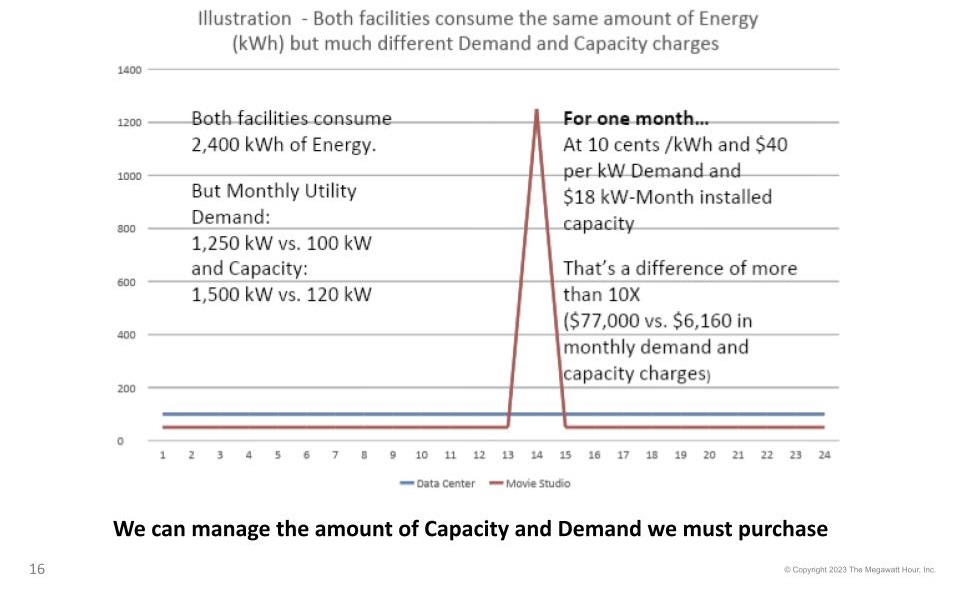
Reducing load during peak periods can decrease demand charges and overall energy consumption. Large energy users who participate in these programs can also receive payments for reducing their electricity usage during peak hours. Managing demand and capacity during peak periods can be an important and lucrative undertaking, as you can see from the following graphic. Two customers (in this case a movie studio, in red, and a data center, in blue) can have the same kWh usage with dramatically different kW peak demand. Both facilities consume 2,400 kWh of energy on a single day. Monthly utility demand reaches 1,250 kW for the movie studio when they’re producing a film vs. 100 kW for the data center. Capacity is a similar story: 1,500 kW vs. 120 kW. For one month at 10 cents /kWh and $40 per kW Demand and $18 kW-Month Installed Capacity (ICAP), that’s a difference of more than 10X ($77,000 vs. $6,160 in monthly demand and capacity charges).
So, how do customers effectively make the most of operational flexibility? There are a number of programs in NY state and across the country that can help customers lower their demand and capacity and achieve the benefits of these programs.
Emergency programs are designed to maintain grid reliability during unexpected contingencies or extreme grid conditions.
Peak Shaving Programs alert people to reduce their energy usage at peak hours to reduce cost.
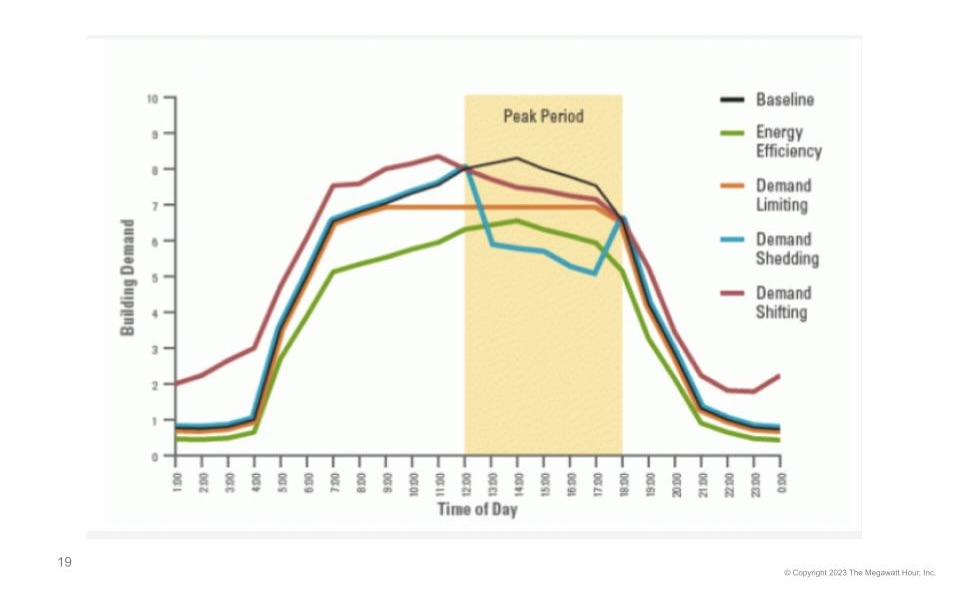
Demand Shedding is the most common strategy of reducing loads for demand response. Examples of how to shed load include turning equipment off, stopping production lines, or shifting energy usage from electricity to steam and countless other methods. The ability to shed demand at certain times can be very strategic and can result in cost reductions for a single month or, in the case of ICAP Tag reduction, the entire year.
Customers are paid to reduce their electric load during key time periods. The value of participation is extraordinary – 1 Megawatt of load reduction is worth over $250,000. in NYC in 2023. Payments are made to customers whether the program is activated or not – like a reservation payment. We may not be able to do much about the price of capacity or demand but we can affect how much we have to buy.
Contact an Aggregator like Innoventive Power, who will:
Evaluate the facility for DR strategies and quantify the potential value
Enroll the facility and operate the program
Customer responsibility is to execute the load reduction plan when called
Finally, communicate openly and often with your colleagues: Over communicate dynamics in the marketplace so you can feel confident in providing advice to colleagues. Transparency through communication is key to inform decision making especially as we confront dynamic market conditions.
Final Advice
Notice changes in the industry. Customers cannot afford to ignore market dynamics. Pay attention to what is driving energy costs today and into the future. This will allow you to make reasonable and responsible decisions.
Use markets to your advantage. Be flexible!
Understand and participate in demand response programs.
Use evidence and knowledge to make decisions, use these tools to navigate the transition.
Set goals, identify a strategy, manage budgets, and communicate.
The energy grid and energy markets are in transition and will continue to be over the next several decades. This transition is causing disruption and volatility in energy markets. This past July, The Megawatt Hour and Innoventive Power co-hosted a webinar titled “Energy Market Dynamics: How Best to Manage Risk and Costs “ (you can listen to the Webinar here) to explore this topic in detail. The Webinar’s goal was to familiarize commercial and industrial customers with energy markets, this transition and what you need to know to manage energy costs effectively in this environment. Innoventive Power and The Megawatt Hour were able to focus on both supply and demand side strategies during the hour-long session. This article and the one that follows, “Energy Market Dynamics: Keys to Navigating Volatility”, summarize the main points presented during the Webinar.
Over the past 12-18 months, most power purchasers will have noticed that prices were higher and more volatile than they have been in over a decade. Why? There are a number of factors, including a supply-demand imbalance largely brought about by the global pandemic. Another key factor contributing to dynamic markets is that the grid is in transition from a more fossil-fuel based, centrally managed power grid, to a greater reliance on renewable energy and distributed resources. Why do you care about market volatility and a grid in transition? Well, two reasons, really: cost + reliability. Let’s start with cost.
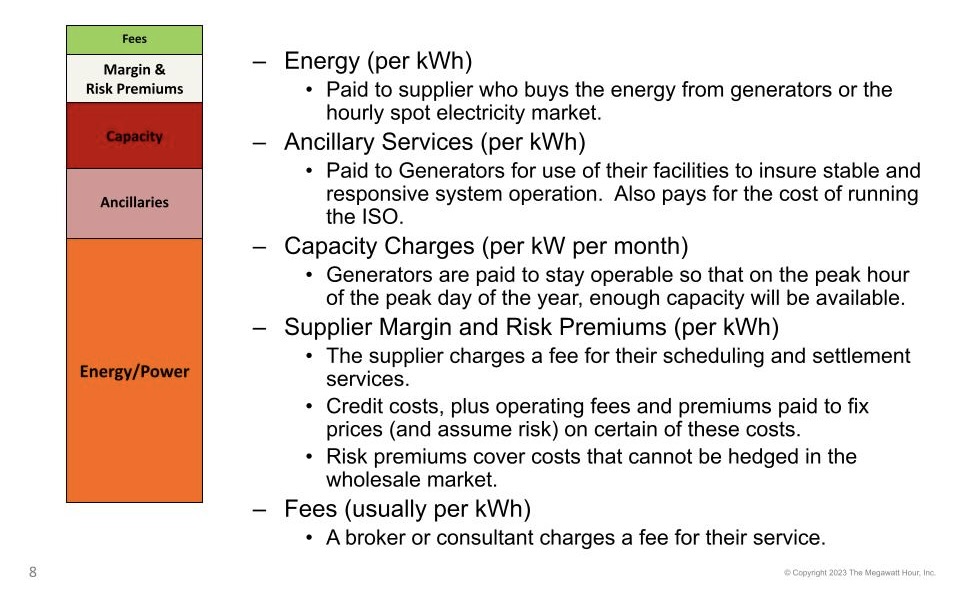
As consumers of energy, all customers participate in financial markets. Energy users, you pay your supplier for the cost of Energy, Ancillary Services, and Capacity. With this information, customers can understand the different components of costs to track and improve their budgets. No matter what you do, you are engaging in energy markets– whether you’re buying from your local utility or a third party supplier. Energy markets are financial markets. That can often lead customers to feel somewhat helpless, at the mercy of markets. Understanding the components of cost will help you to control and, we hope, ultimately manage these costs effectively. If you were to go out to a supplier (an ESCO or REP) and ask for an electricity price right now, the following are the components of supply cost that the supplier would consider in order to provide you a price (see graphic, below).
Energy: The first and largest component of cost is the energy cost. This cost, to be a bit technical, is the ISO load zone cost that includes everything needed to generate the power and move it through the ISO high-voltage transmission system to the area where your load is situated. Customers pay suppliers for Energy in units of kilowatt hours or kWh ($/kWh).
Ancillary Services: Secondly, a customer is charged per kWh for ancillary services. These charges cover the cost of using generator facilities to ensure a stable and responsive system in addition to covering the cost of ISO operations. These costs are becoming more relevant to customers as the grid transitions.
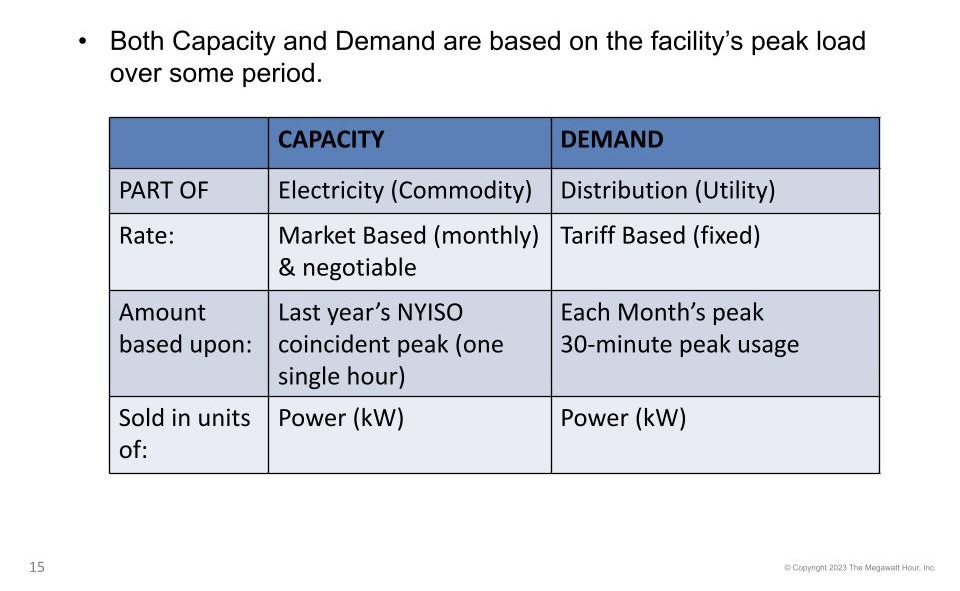
Capacity: Next, a customer pays a capacity charge per kW per month. The capacity charge is a payment to generators to simply be available for power generation when system loads peak. NY has a capacity market– neither Texas nor California have a capacity market. Capacity payments ensure generators can operate during the peak hour on the peak day of the year. A customer’s capacity or “ICAP tag” represents a customer’s load on this peak hour multiplied by a reserve margin and determines how much Capacity (in units of kilowatts or kW) the account much purchase for the entire year
Supply Margin and Fees: Lastly, customers pay suppliers a profit margin and risk premium. If you hire a broker or consultant for advising, suppliers will often add these to the supply cost as an extra cost.
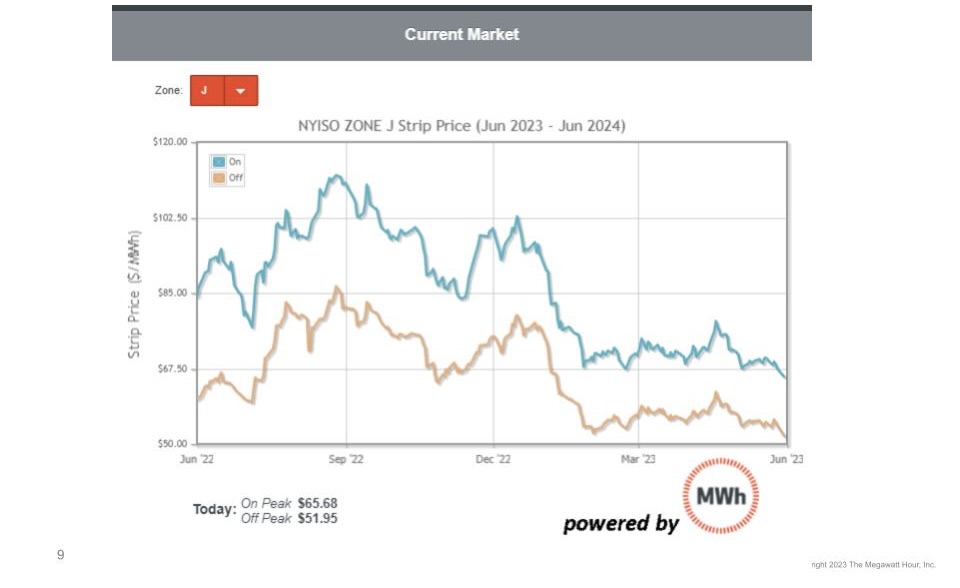
The graphic, below, shows that there has been significant movement over the course of the year in energy markets. This graphic demonstrates the volatility we have experienced in NY markets over the past year. It will look much the same for any market. To orient you, a forward strip of power is what you would buy from a supplier for the largest portion of your supply bill, Energy (that orange part of the bar that we just looked at). This graph shows how the same forward strip of power has moved over the last year.
On the far left side of the graph you can see what you would have paid if you bought power for June 2023-June 2024 a year ago (which you can do, by the way). A year ago, you would have paid $85/MWh for on-peak power. If you bought in Sept ‘22, you would have paid over $110/MWh, if you bought more recently, you would have paid $65-$67/MWh. That’s a swing of 40% in a few short months.
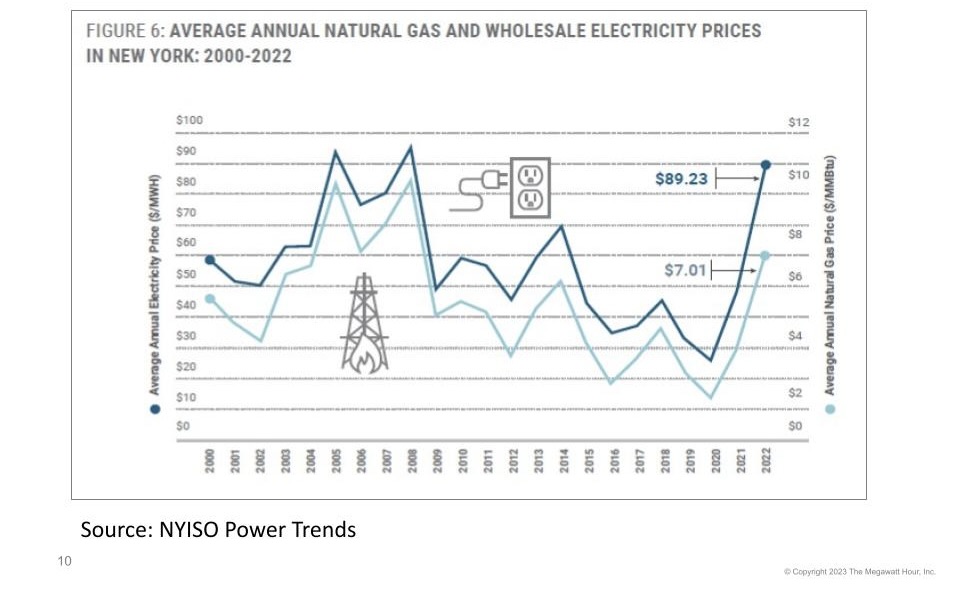
Most of this variability is driven by changes in gas markets. As you will notice, from the graphic below, natural gas is the underlying fuel for electricity generation which typically sets the marginal price for power in NY State and in many markets. When gas prices are high or volatile, so are power prices. One thing to keep in mind, however, is that we are transitioning away from fossil fuel driven power generation… so we don’t know what will set the marginal cost of power in the future. That uncertainty will likely contribute to continued volatility in markets in the next decade or so… Throughout the grid transition, we expect continued volatility and the potential for significant changes in energy costs, which is why it is important to pay attention to market dynamics.
So, now that we’ve provided you with some indication of what to expect from energy markets, what can you do about it? Is there any way to manage through these challenges and volatility? The second half of the July Webinar focused on how customers can respond to dynamic markets. We summarize our recommendations in the following article titled “Energy Market Dynamics: Keys to Navigating Volatility”.
New research shows that underground heat given off by buildings is growing and is a potential risk to the environment and general infrastructure. Rising underground temperatures may be compromising the safety of civil structures.
Most underground structures, such as basements, parking garages, subways, and tunnels, release heat that warms the rocks and soil they were built in. Over time, geological layers expand and contract, and potentially damage the supporting rocks and soil and risk shifts. Excess heat can deform rocks and soil, and, potentially, the construction materials embedded within it.
One major study in Chicago’s Loop involved the usage of 150 temperature sensors throughout the surface and subsurface environment in the Chicago Loop to determine trends and correlations between outdoor and subsurface temperatures throughout the seasons in building basements, parking garages, and tunnels.
Analysis of the temperature readings showed strong correlations between the temperature at the surface of the Loop and those in certain underground structures, based on how deep the structure is and the use of the area. Building basements tended to be hotter because of boilers and other processes used there. Older buildings generated more heat, presumably, because they are less energy efficient to use waste heat. However, whether heat is generated in the space or not, higher-than-expected temperatures were measured. In addition, these higher temperatures could, in time, cause millimeter-level soil deformations. The researchers believed this would not compromise structural integrity but may worsen operational efficiency.
It should be noted that these results may differ in other areas based on the density of big buildings, their uses, the soil structure (Chicago has high-clay soil which conducts heat more than rock), and the location of Lake Michigan and the Chicago River not far away (acting as a heat sink).
Therefore, if excess heat is produced and found in underground structures and tunnels, might it be part of the solution for Climate Change and energy efficiency? Might ground source heat pumps be able to use some of the underground excess heat and displace some electricity and fossil-fuel-powered heat/steam generation for comfort? Thus, excess heat may represent an opportunity. Heat maps could potentially be developed to identify the best locations to remove excess heat (reducing collateral damage) and use it for heating buildings or hot water production.
CCES has the experts to help you determine whether air- or ground source heat pumps might be a solution for you to reduce your energy usage and costs and reduce your greenhouse gas emissions, too. Contact us today at karell@CCESworld.com or at 914-584-6720.
The passage of the Inflation Reduction Act (IRA) in 2022 saw the Federal Government commit billions of dollars in new spending and tax incentives to building energy efficiency and electrification programs. What has been overlooked by some is that the IRA expanded Sec. 179D of the IRS code, the tax deduction for energy efficient commercial buildings. A “commercial” building is defined as a non-residential building and residential buildings greater than 3 stories.
The IRA changed the 179D program so that existing buildings which reduce energy use intensity (EUI) by 25% to 50% from a pre-retrofit baseline are now eligible for the tax deduction. 179D had been tailored more to new buildings which can use energy models to demonstrate energy savings. Thus, existing building owners making upgrades not only save on energy costs but can now use 179D to reduce their tax liability on the property. While the new construction pathway remains, this expands eligibility.
In addition, there is more money available for tax deductions. Before the IRA, the 179D deduction was $1.80 / sq. ft.; now it ranges from $2.50 to $5.00 / sq. ft.
The IRS is expected to issue guidance later in 2023 about how building owners can take advantage of the retrofit pathway, we know that existing buildings would be eligible for the 179D tax deduction by meeting the following requirements:
Cannot have previously claimed 179D deduction as a new building.
Establish a baseline site Energy Use Intensity (EUI). The simplest way is by benchmarking energy usage in ENERGY STAR Portfolio Manager, which calculates the building’s EUI.
Develop a “Qualified Retrofit Plan”. A written plan must be developed by a “Qualified Professional” (licensed architect or professional engineer) that:
Certifies current site EUI;
Describes the recommended upgrades to interior lighting, heating, cooling, ventilation, hot water, or envelope systems;
Certifies that the recommended building upgrades were installed, and;
Demonstrates that the building’s improved site EUI was achieved due to the building improvements.
Reduce Site EUI by at least 25%. Buildings are eligible for a $2.50 / sq. ft. deduction for cutting site EUI by 25% rising to $5.00 / sq. ft. if they reduce the EUI by 50% or more.
The updated 179D requires projects to meet wage and apprenticeship standards on the project—including for contractors and subcontractors. Projects that do not satisfy these labor standards are still eligible for tax deductions, but at a significantly lower rate.
CCES has the experts to help you understand 179D and perform the steps above to take advantage of the revised rule and provide a significant tax benefit for upgrades to your building, besides saving significant energy costs. Contact us today at 914-584-6720 or at karell@CCESworld.com.
Plastics are ubiquitous in our daily lives. They are reliable, cheap, strong, lightweight, and resistant to corrosion. Thus, they are used for packaging, building components, medical (syringes and pipettes), even clothes, and, perhaps ironically, environmental control (gloves, bags). Imagine the sanitation issues of carrying toiletries and personal hygiene products that are not in plastic? Plastic packaging is often the best way to maintain a product’s integrity during transport. And plastics are cheap. Imagine the cost to low-income families if they had to buy items with more expensive packaging?
What are plastics? They are polymers, long chains of molecules made from repeating compounds (monomers). Most originate from chemicals found in crude petroleum. Thus there will be the need for oil exploration and refining, even if all transportation vehicles switch to electric. Some modern plastics do use other materials, like corn or cotton. Plastics’ molecular structure can be engineered to effect different characteristics—to be flexible or hard, transparent or opaque. They are durable, strong, lightweight, water resistant, and relatively easy and inexpensive to manufacture. There are thousands of patented plastics, all with unique attributes that make them fit for purpose.
However, plastics have a large adverse environmental impact.Very large! In fact, plastics is causing a global pollution crisis. In whatever form plastics are found, they tend to degrade in time due to radiation from the Sun to “microplastics” – not to the molecular level, but to a tiny state that is hard to separate. Given that 80% of the Earth is made up of water, most plastics end up in our oceans, seas, rivers, etc. A recent study identified 15,000 different micro-plastic compounds deriving from one disposable plastic shopping bag. Many of these micro-plastic compounds become airborne and can reach deep into lung tissue, causing various lung ailments. In our waters, there is an estimated 75 to 200 million tons of plastics, with about 33 million tons added every year. Fish and mammals consume them, including larger plastic particles which can poison or perforate their GI tract. The “Great Pacific Garbage Patch” contains an estimated 1.8 trillion pieces of plastic and is twice the size of Texas. Perhaps you think you do not ingest plastics; you carefully remove food from containers and all. But micro-plastics are found in our stool (even in an newborn’s first stool) and incorporated in our body parts.
So perhaps you think the problem can be solved by recycling. More municipalities than ever perform plastic recycling and more households take part. However, much of the plastics put into recycling ends up in the trash anyway (and to incinerators or landfills) because of the quality of the melted monomers produced in recycling plants (contaminated with other materials or other monomer types). It is cheaper and higher quality to produce plastics from virgin sources than from recycled plastics.
What are the answers? The first is to be aware. This is a global problem that impacts the entire planet. The next is to go beyond recycling, to reduce usage and demand for plastic products altogether. Many municipalities now ban single-use plastic bags at, say, supermarkets. However, substitutes may have their own problems, such as a higher carbon footprint. Also, this would result in people changing their lifestyles in how they purchase or use items and this is difficult. We are used to our plastics-dominated society. Be aware there is an issue and think through how you best can help.
CCES has the experts to help your firm deal with excessive plastics or other materials and to find economic potential substitutes. Contact us today at 914-584-6720 or at karell@CCESworld.com.
New York City’s Local Law 97 (LL 97) goes into effect soon: January 1, 2024. It will have a great impact on real estate in NYC. Other cities are looking at this and may copy.
What is LL 97? Starting on Jan. 1, 2024, any energy used by a subject building (virtually any building greater than 25,000 sq. ft.) will count toward a greenhouse gas (GHG) emission limit. LL 97 contains factors that convert kWh of electricity to kilograms of GHGs; factors that convert therms of natural gas to GHGs; and factors that convert the number of gallons of #2 and #4 oil used and pounds of steam purchased to GHG emissions. These get totaled up and divided by the building’s listed square footage to get a rate of GHGs per sf. This gets compared to your GHG emission limit (based on what type of building it is: an office building, a residence, a warehouse, a school, etc.) to determine whether you comply. By May 1, 2025, a subject building must submit their 2024 energy usage to the NYC Dept of Buildings to determine compliance with the site-specific limit or not. The fines for some are anticipated to be 6 figures per year.
How to comply. To meet your GHG emission limit, your building must be more energy efficient (use less energy to perform necessary functions) and/or use “cleaner” energy (defined as energy that emits less GHGs). It is critical to perform a thorough energy evaluation and see where you stand on LL 97. Are you likely to be in compliance next year or not? How high might your fine be? For example, take actual energy usage from a recent year and see if it would comply if the same energy usage would be the same in 2024. An important note: if such a study shows that you comply in 2024, but barely, do not celebrate. Things can change between that baseline year and 2024 (equipment aging, tenant behavior, and, most likely, the weather). You want to not just comply, but comply with a buffer to withstand a worse-than-expected winter or summer causing you to use more energy for tenant comfort.
If you need to make changes to avoid or reduce a potential fine, it is probably too late now to implement many strategies. But if you are facing a fine, one should have such a thorough evaluation done NOW. For example, one strategy is to stop burning oil for heating and use natural gas instead (if available). While there may be an upfront cost to upgrade your burner to burn gas, that cost will be made up in reduced fines in 2025 and beyond and that natural gas is cheaper than oil (and has been so for over a decade).
Another strategy is efficiency. Now is the time to invest in energy efficiency which will help you comply with LL 97 (reduce your GHG emissions), and also lower one’s natural gas and electricity bills, which we know has grown at rates much greater than inflation recently. A thorough energy audit will likely point out several beneficial strategies.
Final note. Some people ignored LL 97, thinking that the new mayor who took office last year would weaken and perhaps even repeal it. This did not happen. In fact, Mayor Adams is a strong proponent of LL 97 and his Buildings Dept amended the law this past January to make it more comprehensive. Don’t ignore it any longer; don’t wait for it to take effect. It would be too late then to avoid potential massive fines. See LL 97 as not just another law you must comply with, but as a way to save costs and serve your tenants better.
CCES has the experts to address LL 97 and other NYC energy local laws. We can perform the evaluation of your potential compliance status vis-à-vis this rule and develop multiple strategies to reduce or eliminate fines and provide other financial benefits, as well. CCES can also be your project manager to help implement strategies that you choose to ensure they are implemented correctly and you get the most benefit from them.
So we all thought we were done with masks as COVID has lessened from a pandemic to a manageable issue (and fewer deaths than before, but still about 60 Americans die every day from COVID). We had to wear masks indoors. Well, now masks are back, but we should be wearing them outdoors! All because of very high levels of particulate matter (PM) in the air being brought here from hundreds of wildfires throughout Canada. Hot and dry weather earlier than normal, in part due to Climate Change, has caused a record number of forest fires earlier than usual and too many to control. An estimated area the size of South Carolina is burning (spread throughout 4 time zones) and the ashes are picked up by weather patterns and blown into the US. Air pollution certainly knows no national borders! Air quality has reached dangerous levels healthwise in New York City, Chicago, Washington, Minneapolis, and other major metropolitan cities.
Why is this a problem? The smoke from wildfires contains many compounds that are toxic to us, including products of incomplete combustion. Perhaps the most injurious is ultrafine particulates, smaller than 2.5 microns (one-twentieth the diameter of a human hair), which can penetrate our defenses, get into our lungs, and cause substantial damage. “PM2.5” can damage lung tissue, get into our bloodstream and has been found to damage other organs (the liver, the brain).
Research appears to show that PM2.5 is especially dangerous for children whose systems are still developing but have immature immune systems. Studies have shown that even before the latest events with the wildfires that there is a correlation between high PM2.5 levels and poorer test scores, more teenage crime, etc.
So what can we do? In the short-term, check daily the air quality in your area. If the index is or will be that day 100 or greater, be concerned, and if it is over 150, protect yourself by wearing a N95 mask or equivalent outdoors. It won’t filter out all of the PM2.5 but will remove a good portion of it. In addition, if your area could reach index levels of 150 or greater in the future, implement safeguards for your indoor air, such as installing high quality air conditioning filters. Ensure that the building you work in meets ASHRAE standards for indoor air quality (IAQ), which includes ventilation to dilute pollutants and filtration to remove particulate and other matter.
In the longer term, what can be done to reduce wildfires in the US or elsewhere? Many are caused by lightning, which is beyond our control. However, the conditions that enable wildfires to grow and unleash large amounts of pollutants are influenced by Climate Change. Efforts to reduce greenhouse gas emissions, such as replacing fossil fuel combustion with renewable energy, is a good long-term step. But also, many forest fires are caused by human carelessness. So be sure when camping this summer season to be aware of your actions that could cause a spark and ignite a fire.
The PM2.5 air quality issue is not going away. More wildfires will occur releasing more pollutants this summer and in future years. Be aware of it, carry a mask around, and be mindful that this is not a matter to take lightly.
CCES has the experts to help you assess your air pollution issues and help you react to conditions or reduce your emissions in an economical way. Contact us today at 914-584-6720 or at karell@CCESworld.com.
The “environment” is coming back. While the previous Administration reduced funding to enforce environmental rules, this one has restored funding and has reversed many of the rules that had been made more lax. Maybe more important is with the growing concern with health caused by the pandemic and the reduced air quality from the Canadian wildfires, it is more important than ever for a company, a building, big or small, to elucidate a concern and policies resulting in a positive, healthy environment for people to live or work in. An environmental policy is a statement, putting into words such sentiments. While voluntary, it can go far to provide common goals to attain and enable stakeholders to feel comfortable, help you be aware of your compliance status of applicable laws, reduce incidents that result in liability, and provide a common front.
There is no standard format for writing an environmental policy, but it is still important that you plan it carefully. For buy-in from Management it is important to emphasize key benefits such as cost reduction, improved risk management and marketing.
One approach in an environmental policy is to show an environmental history of the business, particularly emphasizing gains made in recent years. Another approach is to benchmark your facility comparing environmental achievements to similar businesses.
Here are a few basic rules to follow:
keep the statement short – no longer than one sheet front and back
make sure it is not too technical and can be easy for all to read and understand
focus the policy on your company’s achievements and practices, not general ones
ensure the policy document is signed by the #1 person, the owner, to show its standing
ensure the policy is well communicated (website, bulletin boards, newsletters, etc.)
As you compose your environmental policy, start out with the business mission and how its products help people, while having minimal impact on the environment. Focus on the specific aspects of the business that affect the environment and their potential impacts. Depending on what the company does, these may include air quality, recycling of packaging materials, minimizing waste, clean transportation, minimizing usage of organic solvents, and minimizing noise. Don’t include less applicable issues. The policy should contain commitments to continually improve your environmental performance, to effectively monitor and manage the company’s specific environmental impacts, and to always be in compliance with applicable environmental regulations.
After you state the company’s environmental commitments, it is important to discuss how these commitments will be achieved, discussing concrete efforts in employee training in environmental issues, determining targets and goals, monitoring progress and reviewing performance against these targets.
It may be useful to either integrate your environmental policy with other policies on health and safety, corporate social responsibility or sustainability or dovetail principles between those policies.
Remember, businesses live in a dynamic world. It’s critical to review your environmental policy on a regular basis to assume nothing is outdated or that it is improved to include new conditions.
CCES has the experts to help you develop, draft, or review your environmental policy and help implement your program to get the most out of it, maintain compliance, and show stakeholders your concern. Contact us today at karell@CCESworld.com or at 914-584-6720.
The weather is warming up and you are beginning to use much more your rooftop HVAC system. To ensure that the system is working reliably in this hot weather and is performing optimally depends on maintaining them properly. In addition, well-maintained equipment will last longer and delay the spending of lots of capital to replace them. Thus, here are some tips to help you with the maintenance of your rooftop HVAC system, including steps you can take in-season. Be careful working with rooftop HVAC units, in terms of safety. If you are unsure of certain steps, make sure to bring in an experienced, professional HVAC firm to perform the tasks.
Regular Inspections. Schedule routine inspections of your rooftop HVAC system, at least twice a year and, ideally, at the beginning of the cooling and heating seasons. Turn off the equipment, remove covers, and go “inside” the equipment to identify any potential physical damage or signs of wear and tear.
Keep the surroundings clean. Well, at least keep the area around your rooftop units clear of debris, vegetation, and any other obstructions. This allows for proper airflow and prevents the accumulation of dirt on filters and other parts.
Clean the coils. The condenser and evaporator coils are essential and dirt, dust, and debris can affect their ability to work. Use a soft brush or low-pressure water to clean them gently.
Replace filters. Dirty filters restrict airflow, reducing system efficiency. Replace or clean the filters regularly. Follow the manufacturer’s recommendations. But pay special attention to unique features of your area. For example, one client cleaned rooftop filters once every 3 months, per recommendation. But the site was near several gravel and sand pits, necessitating more frequent changes as the neighbor’s material became airborne more than in a “typical” location.
Check fan blades. Inspect the fan blades for damage or imbalance. Ensure that they are clean and free from debris. If you notice any issues, contact a professional to address them.
Inspect belts. First, listen to your system for any unusual noises or rocking of unstable belts. Check the condition and tension of the belts that drive the fan. Replace worn-out, cracked, or out-of-alignment belts to prevent system failures.
Lubricate moving parts. Lubricate the bearings and motors per manufacturer’s recommendations, reducing friction and extending the lifespan of the components. And this improves energy efficiency, too.
Check electrical connections. Inspect the electrical connections, wires, and terminals. Ensure they are secure and free from corrosion. Loose or damaged connections can lead to system malfunctions and should be repaired promptly.
Monitor refrigerant levels. Low refrigerant levels can indicate leaks or other issues. Regularly check and monitor the refrigerant levels to ensure optimal performance. If you suspect a leak, contact a professional HVAC firm for repairs.
Professional maintenance. Consider hiring an experienced, professional HVAC firm for comprehensive maintenance at least once a year. They can perform tasks such as system calibration, efficiency checks, and detailed inspections. Yes, this costs money, but will save you much more in terms of better efficiency, reliability and longevity.
CCES has the experts to help you assess your HVAC equipment and determine any potential problems in operations. Contact us today at 914-584-6720 or at karell@CCESworld.com.
Many building owners and managers wonder whether to invest in a Building Management System (BMS). After all, why complicate life? A simple system may be less of a hassle. But here are 6 reasons to not only procure and implement a BMS to manage your building operations, but to invest in a smart one.
Energy cost savings. A BMS allows for precise control and optimization of your heating and cooling, allowing energy usage only for the areas and times of your choosing – when it is needed most. BMS can control not only HVAC, but lighting, too. By monitoring the actual situation (is a room occupied and, therefore, needs to be lit and heated or cooled?), one can minimize energy waste, resulting in a potential substantial savings on utility bills.
Improve operational efficiency. A BMS can control in a consistent manner many far-flung systems, providing reliability that programmed settings will operate, saving labor of checking on or manually manipulating systems far away. Reliable, consistent operations is important to you as an owner or building manager.
Pinpoint changes, as needed. A proper BMS can allow the manager to make changes to specific areas as occupancy or other conditions change quite easily, resulting in greater comfort of the room users. Whether it be lighting, heating, or cooling, BMS allows one to make quick, small changes as needed for a user.
Develop trends and learn. A BMS not only adjusts equipment, as necessary, but can detect and evaluate trends which can teach you about your business and your clientele to make informed future business and/or energy decisions.
Equipment longevity. Saving long-term capital costs. With a BMS controlling equipment so they are on only when needed, said equipment will be used fewer hours over a time period compared to not having a BMS. As a result, equipment will undergo less wear and tear over time and stress out the total electrical system less, as well. Therefore, one can “stretch out” the use of equipment for a longer time, reducing long-term replacement capital costs.
Regulatory/program compliance and meet goals. A growing number of entities have developed sustainability goals or must comply with new energy or sustainability regulations. Many of these are tied to energy usage. A BMS, by reducing energy waste, will help your building more reliably comply with the internal standards or regulations.
In summary, implementing a thorough, smart BMS for energy efficiency provides real, long-term financial savings by reducing energy waste, yet also provides reliable comfort to occupants. A BMS also improves operational efficiency and more reliably helps the building meet regulatory limits and/or internal sustainability goals. All this is automated, saving management work and aggravation. So not only should you consider implementing a BMS, but look to procure a system that meets all your needs reliably.
CCES has the experts to help you assess which type of BMS is most useful and beneficial for your building, based on current needs and physical factors of the building. Contact us today at 914-584-6720 or at karell@CCESworld.com.